


Family + Full time job plus….4 live projects…
Then we have three sessions in August, all on the same Wednesday, and they turned out to be the same conversation from three angles. Here’s what actually stuck.
1. Reducing quality reporting burden with FHIR (ICF)
With Bridget Calvert of CMS/CCSQ, Benji Graham, and John Auerbach. Around 212 registrations, heavily CMS and CDC.

Terminology is a real adoption barrier, not a footnote. We spent prep time deciding to always spell out “SQL on FHIR” rather than abbreviate it, and never to pronounce it “sequel,” because it gets confused with CQL (Clinical Quality Language) constantly. Same with DQM: write out “digital quality measure.” If a room of CMS and CDC people can mishear the name of the technology, that friction shows up downstream in procurement documents, RFPs, and architecture decisions. Naming is infrastructure.
The technical stack is settled; the governance is not. FHIR APIs, bulk data access, and computable measure logic are all real and available today. The open questions in the room were about implementation, governance, and alignment with CMS interoperability priorities. That’s a different kind of problem than the one most vendors are selling into.
Registration volume is itself a signal. 212 people showing up for a webinar on quality reporting burden tells you the burden is not a niche complaint.
2. When Patients Bring Their Own AI (HIMSS Keystone Chapter)
August 19. A live demo of an AI assistant working against real health data behind always-on guardrails.
The premise: patients and family caregivers are already using AI assistants to read lab results, manage medications, and prep for appointments. That is happening with or without permission, and mostly with no protection in place. So the useful question is not whether to allow it. It’s what safe-by-default looks like.
Nobody asks how the model works. They ask what happens when it touches their record. The strongest reaction in the session was to the human confirmation step, not to any capability demo. Going technical on model internals loses the room; showing the propose-then-confirm loop holds it. I’ve stopped opening with architecture.
Open source is the trust mechanism, not a licensing preference. “Our guardrails are safe” is a claim. A guardrail you can read is evidence. That distinction is the whole pitch.
A format note for anyone running these: we cut the session from 60 minutes to 30 because lead time was short and attendance would be small, and we dropped the polls in favor of chat. Both were the right call. Short lead time means a small room. Plan the promotion window before you plan the agenda.
3. CMS Health Tech Ecosystem: Pharmacy Services Working Group kickoff
This is the one I’m excited about. Same morning, the inaugural meeting of the HTE Pharmacy Services Working Group, about 33 participants across pharmacy chains, pharmacy management system vendors, payers, networks, standards bodies, and CMS.
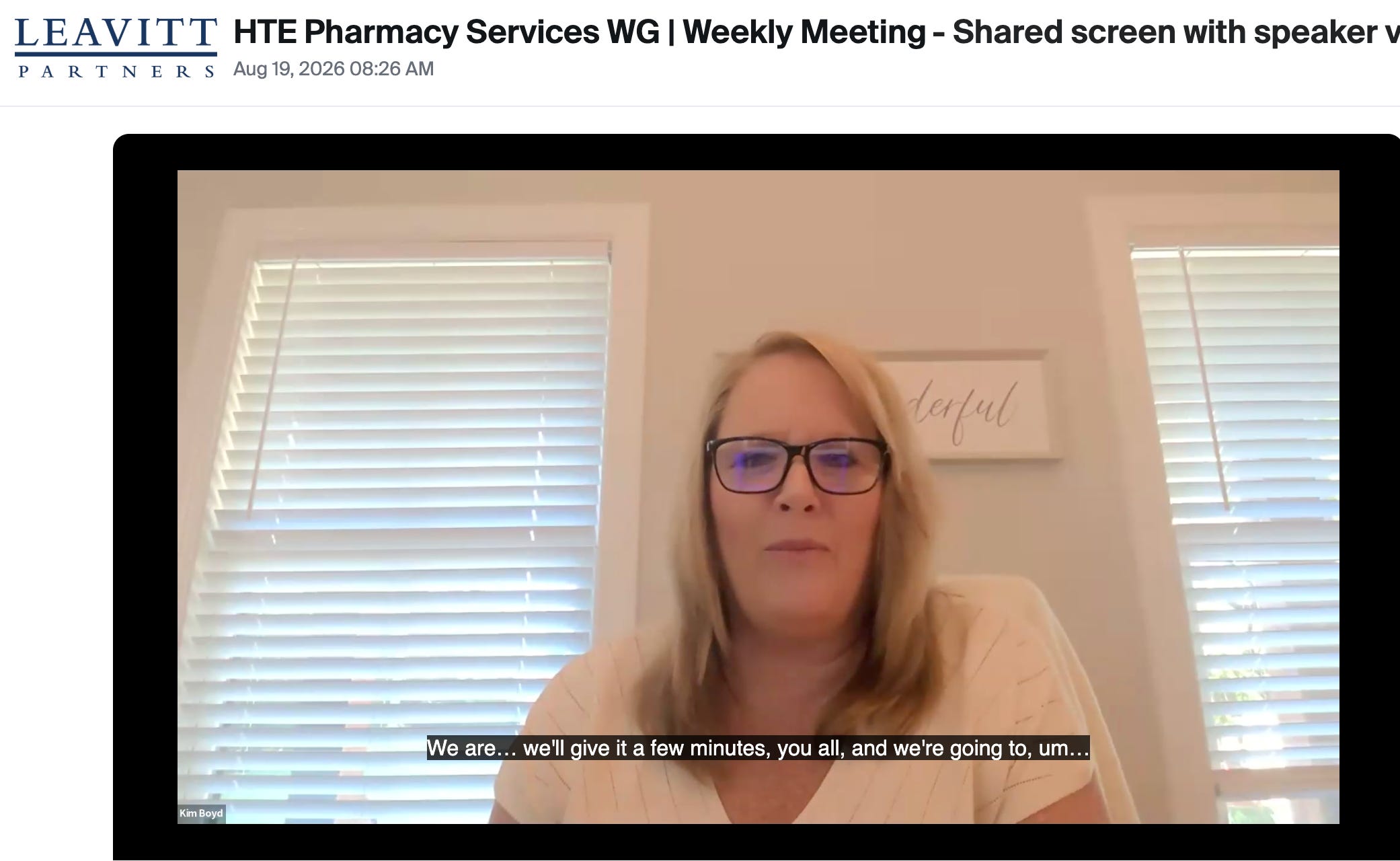
This is the first CMS Health Tech Ecosystem pledge to expand the definition of “provider” to include pharmacies and pharmacists. It was announced and signed on stage at the HTE one-year anniversary event on July 27.
Why pharmacy is the missing link, historically. Pharmacists were excluded from Meaningful Use as eligible providers. So the profession built in parallel for fifteen years: its own SNOMED CT codes, its own PQA quality measures, its own rails. That parallel development is exactly why pharmacy doesn’t plug into the rest of the interoperability stack today. It isn’t an oversight in the standards. It’s a structural consequence of a policy decision.
The “kill the clipboard” framing came from watching a live claims audit that still ran on fax. Pharmacy didn’t fit cleanly into any existing pledge, which is what made the gap visible.
The gap I keep running into. Care agents can pull from CMS-aligned networks and connect to Epic and to payers. They cannot connect to pharmacy. For a patient on five medications, that means the agent can see what was prescribed but not what was actually dispensed, or picked up, or paid for in cash. Independent pharmacies I’ve talked to are eager to pilot, and rural Pennsylvania is a natural place to start.
The scoping risk worth naming early. There’s real pressure to define the MVP as dispense data, because dispense data is the easy part. That would be a mistake. Pharmacists are already doing chronic condition management, counseling, and documented clinical care. If the architecture only carries dispense records, it hard-codes the same narrow definition of pharmacy that the pledge was written to fix. The MVP target is November 1.
What’s next
Podcast conversations with people much smarter than me on health data, agents, and where the two meet. Plus a pile of notes on what actually works when you build with AI and what quietly does not.
More shortly. Stay tuned.
